

Radio emission from GX 339-4 during the LHS is characteristic of a
self-absorbed compact jet (Corbel et al. 2000), similar to that considered
for flat spectrum AGNs (Blandford & K
 nigl 1979).
Regular radio observations have shown that the compact jet of GX 339-4 was
quenched in the high/soft state (Fender et al. 1999; Corbel et al. 2000). Similar
properties have now been observed in a growing number of persistent
and transient BHCs (the jet has even been resolved in Cyg X-1, Stirling et
al. 2001), thus suggesting that compact jets are ubiquitous in BHCs during the LHS
(Fender 2001). In addition to being responsible for most of the
emission in the radio regime, the compact jets may have a significant
contribution in the infrared/optical bands (Corbel & Fender 2002) and
could also be part of the processes involved in producing the X-ray
emission (Markoff et al. 2001). In that case, it would imply that compact
jets are very powerful and could dominate the entire SED of BHC during
their low/hard states.
nigl 1979).
Regular radio observations have shown that the compact jet of GX 339-4 was
quenched in the high/soft state (Fender et al. 1999; Corbel et al. 2000). Similar
properties have now been observed in a growing number of persistent
and transient BHCs (the jet has even been resolved in Cyg X-1, Stirling et
al. 2001), thus suggesting that compact jets are ubiquitous in BHCs during the LHS
(Fender 2001). In addition to being responsible for most of the
emission in the radio regime, the compact jets may have a significant
contribution in the infrared/optical bands (Corbel & Fender 2002) and
could also be part of the processes involved in producing the X-ray
emission (Markoff et al. 2001). In that case, it would imply that compact
jets are very powerful and could dominate the entire SED of BHC during
their low/hard states.
The other main components of the SED are a possible thermal contribution from the accretion disk, which extends from the near-infrared/optical to the soft X-rays, and the possible Comptonisation of accretion disk photons with a hot electron corona, which likely contribute mostly in soft and hard X-rays (Nowak et al. 2002; Done 2002). Despite not being observed, the companion star in the GX 339-4 system is likely an evolved low-mass star (Shahbaz et al. 2001; Chaty et al. 2002; Cowley et al. 2002).
A good way to assess the contribution of jets at high energy is to perform a broadband study of these systems simultaneously at radio and X-ray frequencies, and in particular to study the correlation that could exist between these two emission domains. In fact, such a correlation has already been found for BHC in the LHS, e.g., GX 339-4 (Hannikainen et al. 1998; Corbel et al. 2000) and Cyg X-1 (Brocksopp et al. 1999) for BHC in the LHS. These radio/X-ray observations, however, only sampled a very limited range of X-ray and radio fluxes (or accretion rates). Most of these previous studies also suffered from the lack of sensitivity of the X-ray observations. A similar correlation also has been observed in the hard state of Cyg X-3 (McCollough et al. 1999; Choudhury et al. 2002). A more complex relation, but still indicating a relation between radio emitting electrons and the hard X-ray power law dominated state (like that in the LHS of BHC), is found in GRS 1915+105 (Klein-Wolt et al. 2002).
An interpretation for such a tight correlation is that it is the result of high energy synchrotron emission from the compact jet, as already has been proposed for XTE J1118+480 (Markoff et al. 2001). Alternatively, it possibly could be due to Compton scattering of photons from the companion star or the accretion flow off of the jet's leptons (Georganopoulos et al. 2002). In this paper, we report the results of a long-term study of GX 339-4 performed simultaneously in radio and X-ray during the years 1997-2000, in order to investigate the radio/X-ray correlation over many orders of magnitude with sensitive observations. Evidence for evolution of this correlation with energy is also presented. We discuss these results in light of the jet model of Markoff et al. (2003).
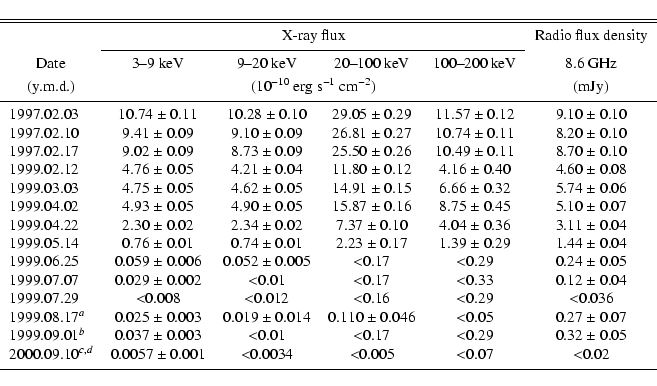
b Average X-ray flux, based on the PCA observations on 1999.08.28 and 1999.09.04. c Radio observations on 2000.09.12, 2000.09.15 and 2000.09.18. d X-ray observations performed by BeppoSAX.
|
Copyright ESO 2003