

Due to the overwhelming amount of time
required to conduct a large-scale survey of the molecular gas distribution in
our Galaxy previous high-resolution ( 1') molecular line surveys
necessarily made pointed observations toward secondary tracers
of molecular gas such as IRAS sources selected on the basis of their
colour, flux density quality, and brightness (e.g., Yang et al. 2002; Wouterloot & Brand 1989, WB89 hereafter). While such surveys provide a
wealth of information on star formation and the distribution of
molecular material in the Galaxy they are clearly biased by the
pre-selection of target locations. For example, in the WB89 survey
region there are 44 454 IRAS point sources. Application of colour and
flux criteria reduce the number of objects examined to 1302 (3%) and it is not unreasonable to expect that some of the 43152 other
objects are also associated with CO. Now that large-scale, unbiased,
high-resolution CO surveys are becoming available it is important to
revisit the question of the association of IRAS sources and CO.
1') molecular line surveys
necessarily made pointed observations toward secondary tracers
of molecular gas such as IRAS sources selected on the basis of their
colour, flux density quality, and brightness (e.g., Yang et al. 2002; Wouterloot & Brand 1989, WB89 hereafter). While such surveys provide a
wealth of information on star formation and the distribution of
molecular material in the Galaxy they are clearly biased by the
pre-selection of target locations. For example, in the WB89 survey
region there are 44 454 IRAS point sources. Application of colour and
flux criteria reduce the number of objects examined to 1302 (3%) and it is not unreasonable to expect that some of the 43152 other
objects are also associated with CO. Now that large-scale, unbiased,
high-resolution CO surveys are becoming available it is important to
revisit the question of the association of IRAS sources and CO.
From 1994-1997 the FCRAO Outer Galaxy Survey
(Heyer et al. 1998, OGS hereafter) mapped out the distribution of CO within the Galaxy
from
 ,
,
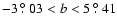 ,
at 45'' spatial resolution sampled every
,
at 45'' spatial resolution sampled every
 and 0.98 km s-1 velocity resolution (1.39 km s-1 for
 )
sampled every 0.81 km s-1.
Recently the OGS data were reprocessed (see
Sect. 2) and a new high-resolution CO cloud catalogue
(Brunt et al. 2003, BKP hereafter) was constructed. The BKP catalogue
provides a concise description of the OGS data and thus facilitates
the comparison of the OGS data with other catalogued data sets. With
the availability of the OGS and the BKP catalogue we were able to
approach the question of IRAS-CO associations from a new direction -
namely we examined all of the IRAS sources within the OGS
region for associated molecular material. The resulting IRAS-CO
association table is presented in this paper and should be of
widespread utility for a number of studies.
)
sampled every 0.81 km s-1.
Recently the OGS data were reprocessed (see
Sect. 2) and a new high-resolution CO cloud catalogue
(Brunt et al. 2003, BKP hereafter) was constructed. The BKP catalogue
provides a concise description of the OGS data and thus facilitates
the comparison of the OGS data with other catalogued data sets. With
the availability of the OGS and the BKP catalogue we were able to
approach the question of IRAS-CO associations from a new direction -
namely we examined all of the IRAS sources within the OGS
region for associated molecular material. The resulting IRAS-CO
association table is presented in this paper and should be of
widespread utility for a number of studies.
In Sect. 2 we first present the data used and the techniques we applied to obtain the IRAS-CO associations. The full table of IRAS-CO associations is provided in the form of an electronic machine-readable table available through the CDS (see Table 1). In an appendix to the paper we explain how one can use the techniques developed for the IRAS-CO comparison to compare any catalogued data set with the OGS-BKP data. Section 3 compares the IRAS-CO associations found in this study to the extensive targeted study of WB89. In Sect. 4 we describe three brief studies which demonstrate the utility of the new IRAS-CO association table. Finally, conclusions are presented in Sect. 5.
Copyright ESO 2003