

We present a colour based selection pipe-line of OA candidates that only requires three quasi-contemporaneous images. The colour selection software is designed to be used in parallel with, or as input to, the normal technique, searching for transient sources through the comparison of observations from (at least) two epochs or with the DSS. Furthermore, it is a method that allows a fast identification of candidates for follow-up spectroscopy also for OAs that are fainter than the DSS limit at the time of first optical/near-infrared observations. Thus, the technique is not meant to replace the normal procedure, but to complement it. The combination of colour-colour and variability information could be a very powerful mean of doing automated OA discovery, with great potential for forthcoming missions like Swift.
The technique has several advantages; it can be applied any time after
the gamma-ray event, using a single set of images in different
filters, and it does not strictly require absolute photometric
calibration. Another additional advantage is that the method is
independent of the redshift, at least for redshifts with a negligible
Lyman- blanketing along the line of sight.
In the case that the discrimination method is based on the R, J, and
Ks magnitudes, it becomes independent of the redshift for
 .
For redshifts
.
For redshifts
 the possible
blanketing effect along the line of sight helps the colour
discrimination. In the range
the possible
blanketing effect along the line of sight helps the colour
discrimination. In the range
 the
blanketing introduces considerable errors in the R-band photometry and
it starts to be an inconvenient. For
the
blanketing introduces considerable errors in the R-band photometry and
it starts to be an inconvenient. For
 the
efficiency is still valid as long as a constraining lower limit on the
R-Ks colour can be derived (
the
efficiency is still valid as long as a constraining lower limit on the
R-Ks colour can be derived (
 ). For extremely high
redshift afterglows (
). For extremely high
redshift afterglows (
 )
the colour-colour discrimination
technique is uncertain.
)
the colour-colour discrimination
technique is uncertain.
This kind of analysis is very suitable for small GRB error boxes such as the ones reported by the NFI of Beppo-SAX or for the ones that HETE-II is expected eventually to determine, in which case the field contamination of quasars and compact galaxies is small.
Using this method we discovered the GRB 001011 afterglow. The
GRB 001011 optical afterglow evolution is consistent with a decay
index of
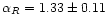 .
With no corrections for the
intrinsic absorption, we derived a spectral index of
.
With no corrections for the
intrinsic absorption, we derived a spectral index of
 .
Therefore, this value of
.
Therefore, this value of  has to be considered
as an upper limit to the unextincted afterglow spectral index. If we
assume negligible intrinsic absorption, the values of
and
are consistent with a spherical afterglow model with an
electron energy index p=2.5. These values also would indicate that
the cooling break,
has to be considered
as an upper limit to the unextincted afterglow spectral index. If we
assume negligible intrinsic absorption, the values of
and
are consistent with a spherical afterglow model with an
electron energy index p=2.5. These values also would indicate that
the cooling break,
 ,
was located at frequencies lower than the
R-band
,
was located at frequencies lower than the
R-band  8 hours after the gamma-ray event. This would make from
GRB 001011 a very interesting system, since in most cases
is
higher than the optical frequencies at early times.
8 hours after the gamma-ray event. This would make from
GRB 001011 a very interesting system, since in most cases
is
higher than the optical frequencies at early times.
Images taken 7 months after the burst reveal an elongated object with
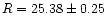 fully consistent with the OA position, likely the
host galaxy of GRB 001011.
fully consistent with the OA position, likely the
host galaxy of GRB 001011.
Acknowledgements
J. Gorosabel acknowledges support from the ESO visitors program and also the receipt of a Marie Curie Research Grant from the European Commission. We acknowledge the availability of the 2MASS and USNO catalogues. This work was supported by the Danish Natural Science Research Council (SNF). We are very grateful to I. J. Danziger for helpful comments. We thank B. Montesinos and D. Barrado y Navascués for fruitful discussions on the contamination by brown dwarfs. The observations presented in this paper were obtained under the ESO Large Program 165.H-0464. We appreciate the useful and helpful comments of the referee, Dr. G. Grant Williams.
Copyright ESO 2002