

We have estimated the interstellar reddening to the source by using the
correlation between the E(B-V) colour excess and the equivalent width of
diffuse absorption features of interstellar origin (Herbig 1975). We used
the lines  4430, 6376/79 and 6613 only since a
clean measurement of their equivalent width can be carried out. Due to the
relative low resolution of our spectra some of the interstellar features
appear blended with other interstellar or atmospheric lines. We find the
mean colour excess to be
4430, 6376/79 and 6613 only since a
clean measurement of their equivalent width can be carried out. Due to the
relative low resolution of our spectra some of the interstellar features
appear blended with other interstellar or atmospheric lines. We find the
mean colour excess to be
 ,
in agreement with an earlier
measurement by M97 of
,
in agreement with an earlier
measurement by M97 of
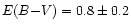 using the same spectroscopic
method. However we find that this estimate suggests a significant
using the same spectroscopic
method. However we find that this estimate suggests a significant
 colour excess when applied to the photometry from 1996
October (Table 3). By comparison we find that applying the photometrically
derived reddening estimate from our data (
colour excess when applied to the photometry from 1996
October (Table 3). By comparison we find that applying the photometrically
derived reddening estimate from our data (
 )
results in no excess emission in the near IR. Additionally, the X-ray data
support a higher value for the colour excess. From a
BeppoSAX observation a hydrogen column density of
)
results in no excess emission in the near IR. Additionally, the X-ray data
support a higher value for the colour excess. From a
BeppoSAX observation a hydrogen column density of
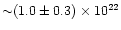 cm-2 is found (Reig, private
communication), implying
cm-2 is found (Reig, private
communication), implying
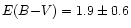 (Predehl & Schmitt 1995) - not
statistically different from the value adopted from the photometric data.
We therefore choose to adopt
for LS 5039 given that it is consistent with both the
near-IR colours of, and hydrogen column density to, LS 5039.
(Predehl & Schmitt 1995) - not
statistically different from the value adopted from the photometric data.
We therefore choose to adopt
for LS 5039 given that it is consistent with both the
near-IR colours of, and hydrogen column density to, LS 5039.
Copyright ESO 2001